

McLaren MP4/1B Carbon Fiber Composite Chassis – Caesar’s Palace Grand Prix 1982
The beginning of the revolution:
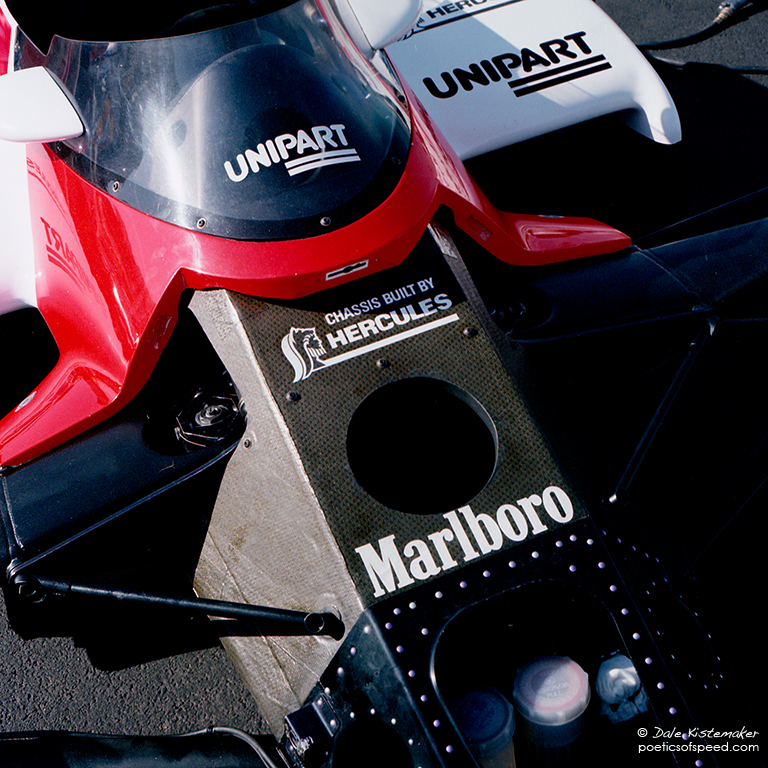 This photograph was taken with my old Hasselblad Super Wide C, a great 120mm film camera with a permanently mounted 38mm Zeiss wide angle lens. It produced staggeringly sharp square images but was slightly difficult to use spontaneuosly because there was only an optical viewfinder on top of the camera for rough framing. For precise architectural and landscape photography I used it on a tripod, removed the film back and replaced it with a ground glass accessory and a chimney viewer from a 500C. On the positive side the SWC was small and light weight and once I was familiar with its performance I could use it handheld. Employing a separate meter for basic exposures I’d set its controls for maximum depth of field and it worked like a very expensive point and shoot camera. I photographed with both 12 and 24 exposure film backs using 120mm Ektacolor 100 ASA negative film. Despite the great image quality it wasn’t flexible enough to handle the fast paced activities of a race and with great reluctance I finally sold it to buy a tool more appropriate for motorsports photography: a second Nikon F3 motor drive camera and additional lenses. Unlike the remarkably stable 35mm Kodachrome slides I regularly used, the color negative images have faded through the years. Despite their technical issues there are some interesting pictures which I will post occasionally.
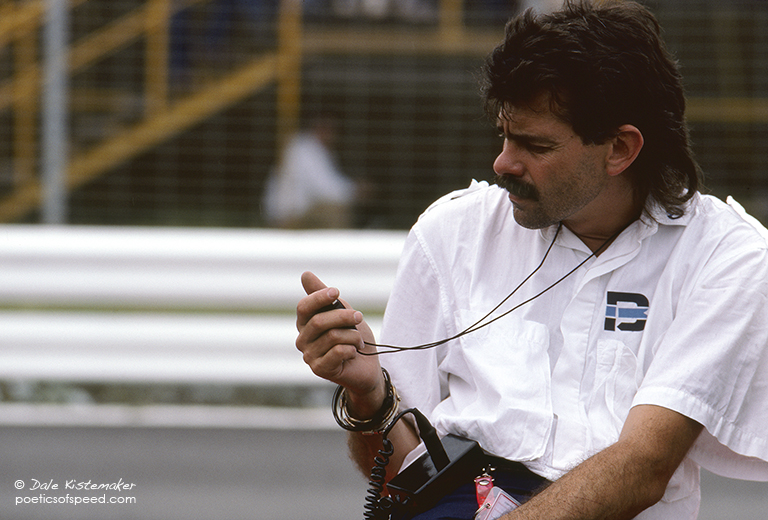
John Barnard – McLaren Designer and Aerodynamicist – June 1984
 My first race with a Photography credential was the 1982 Caesar’s Palace Grand Prix. I attended a press briefing not suspecting I was about to witness an automotive revolution firsthand. The subject was the John Barnard designed McLaren MP4/1, the first Formula One car with an entire chassis using Carbon Fiber Composite. Constructed by Hercules Aerospace, the car on display looked like a fighter jet or a space capsule. The year before John Watson had a horrific crash of his MP4/1 at Monza and survived unhurt. Other teams rapidly rushed to design CFC based cars to capitalize on the chassis rigidity and driver safety.
In 1993 the exhibition “Design For Speed: Three Automobiles By Ferrari” organized by Christopher Mount, curatorial assistant, Department of Architecture and Design, appeared at the Museum of Modern Art New York. The three automobiles in the exhibit were a Ferrari 166 Mille Miglia, Ferrari’s first production car; the fabulous Ferrari F40 supercar and the John Barnard designed Ferrari F1 641/2. Ferrari donated the F1 641/2, to the Museum and, in addition to the Pininfarina Cisitalia 202 GT, became only the second automobile ever included in its permanent design collection.
Carlo Chiti, Engineer, Designer 1924-1994 – German GP 1984
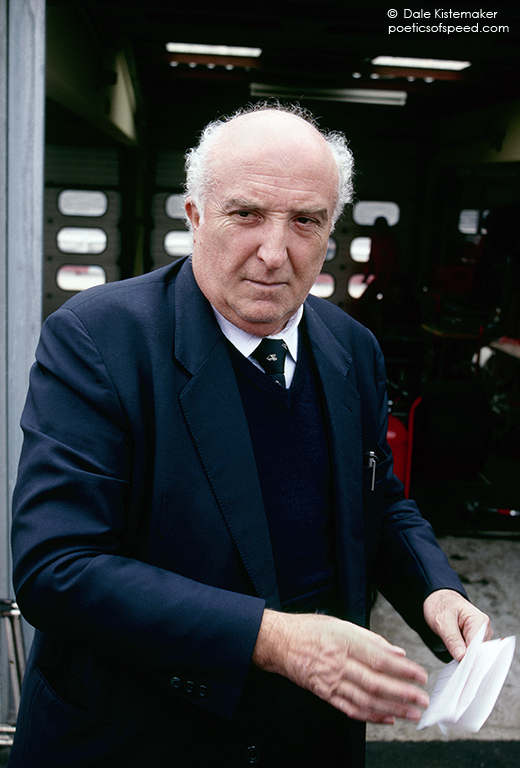 Carlo Chiti’s career in motorsports spanned nearly four decades of racing engine and car designs. Beginning with Alfa Romeo in 1952 he was involved with Ferrari, Bizzarrini, ATS, Brabham, Minardi, Coloni and Subaru . His own business enterprises of Autodelta and Motor Moderni featured his beautiful engine designs: https://poeticsofspeed.com/category/grand-prix-people/carlo-chitti/ .
Further info: http://www.grandprix.com/gpe/cref-chicar.html, http://www.ultimostile.com/my-blog/2012/12/carlo-chiti-modern-motor-man.html

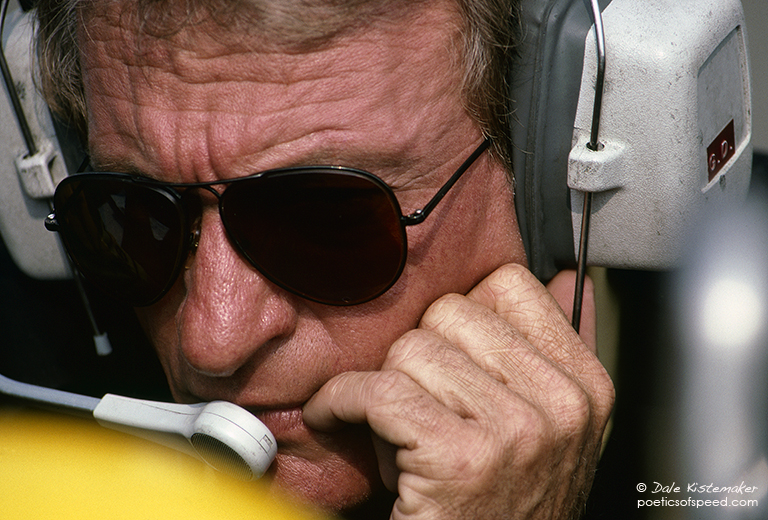

Gérard Ducarouge – Designer – Team Lotus – Monaco 1985
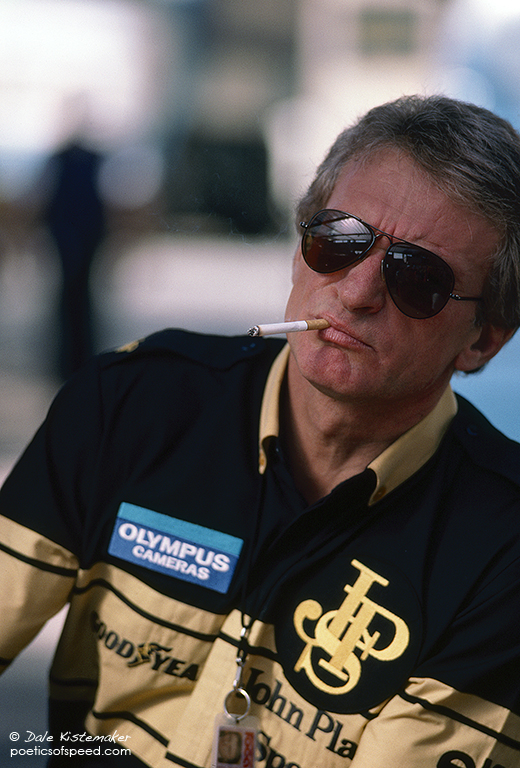 Gérard Ducarouge, an engineer trained in aerodynamics, first worked on missiles but moved to auto racing. At Matra, starting with their F3 and F2 programs he eventually became Head of Operations designing several F1 cars including Jackie Stewart’s 1969 Championship winning car. His development work brought Matra Le Mans wins 192-74.
A successful stint at Ligier F1 was followed by a move in 1983 to Lotus after Colin Chapman’s death. His efforts with the team were successful and brought Lotus out of a difficult period. Ducarouge’s 1984 Lotus 95T was highly regarded and its great consistency brought Elio de Angelis a third place in the World Championship without winning a race. In 1985 Senna came to Lotus and won his first F1 victory in the Portuguese GP at Estoril with Ducarouge’s Lotus 97T.
More details at: http://www.grandprix.com/gpe/cref-ducger.html and http://www.f1fanatic.co.uk/f1-information/whos-who/whos-who-d/gerard-ducarouge/

 poeticsofspeed
You must be logged in to post a comment.