
Vérification: Jaguar, 24 Hours Of Le Mans
I love the tension and drama of the scrutineering of race cars at Le Mans. Competitors have vast amounts of time, effort and money invested in constructing their entries for the 24 hour race. They have solved the logistics of transporting the cars, spare parts, tools and support equipment, sometimes across oceans, and found housing and meals for the drivers and team personnel. But before they can place the cars on track for the first practice session the gauntlet of Vérification must be run. This technical inspection is set up in a large open space, La Place Des Jacobins, in front of the Cathedral in the heart of the city of Le Mans. Crowds line the area behind barricades because it is a chance to see the cars, drivers and teams up close.
Racers are clever people always looking for a creative interpretation of the rules in the design and fabrication of their cars. But in the inspection every measurement is critical. A simple miscalculation can add a millimeter or few grams too much or too little and then all that work getting here is for nothing. There can be arguments, sometimes quite heated, but until that official sticker is issued and placed on the car nothing is for certain.

My 956
At the time I rode with Derek Bell at Le Mans I was uncertain about whether it was in a 956 or 962 Porsche. Both models are visually very similar and were present at the 1985 Le Mans. New-Man Joest Racing, the eventual winners, had 956s. Rothmans, the factory team for whom Bell was driving, were shown on the entry lists with 962s. So I assumed my ride, the T car #111, must be a 962.
A few days ago while researching another photograph I came across an amazing website http://www.racingsportscars.com/. They state: “A primary focus is to create a huge photo archive containing all major national and international sports car races and to collect views of every single car in the field.” It is a fantastic effort and resource. On the 1985 Le Mans page I found the record of car #111 with its data. It was a Porsche 956 chassis 009, a T car driven only in practice by Hans-Joachim Stuck, Derek Bell, Vern Schuppan and Al Holbert. Its best lap was 3:19.720 (the best Rothmans 962 had a 3:14.800).
Now I finally have confirmation I was in a 956 and with its chassis number I was able to determine the car was a real warrior with one the best records of all the 956s. With Derek Bell and Stefan Bellof driving, 956-009 won seven World Championship 1000 Kilometers races and the title for Stefan Bellof in 1984. I am awestruck I rode in his Championship winning car.
956.009 finished well in several other races and eventually was shipped as a T car to four more. According to the 962.com registry 009 was acquired in 2004 by a Porsche Dealership in Reading England. I knew none of these details until two days ago. I thought the ride was amazing enough and now I am astounded to learn I was in a racecar with such an important history.
My posts have now been updated changing 962 to 956.
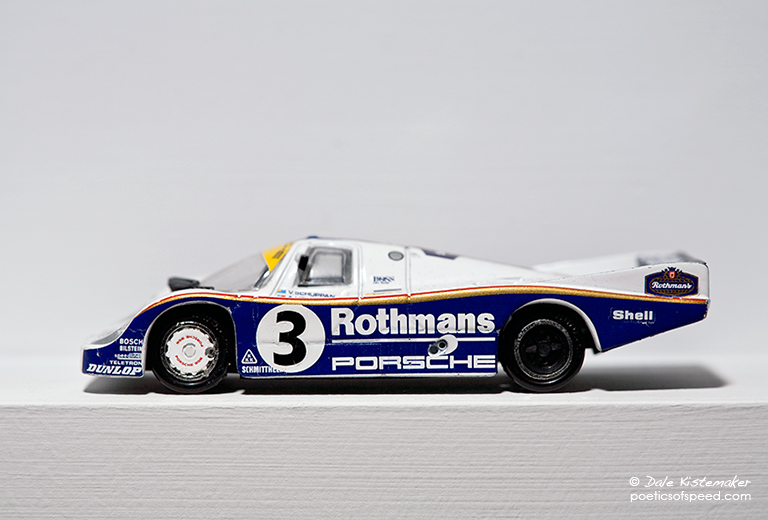
This photograph is of a model Porsche 956 I bought at Le Mans in 1985 right after my ride. For 26 years I’ve always had it nearby. Its currently sitting on a little shelf in my studio about 10 feet away from where I’m writing.


Senna
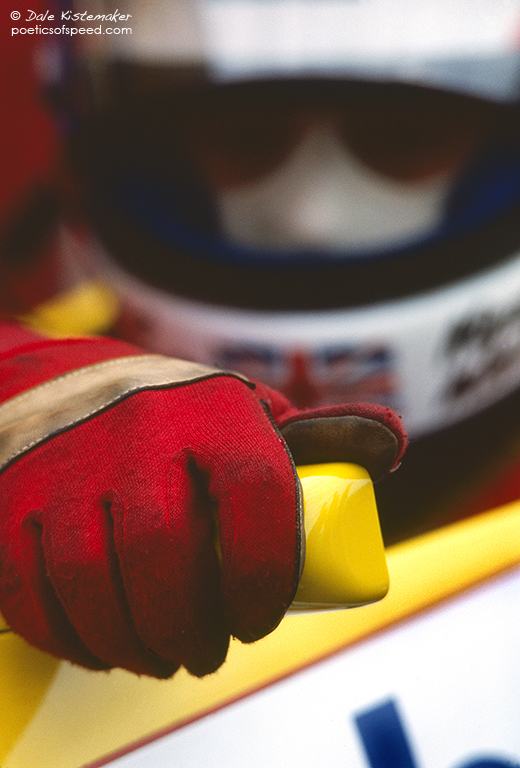
Nearly everyone interested in Formula One during the last two decades knows the accomplishments of Ayrton Senna with 3 World Championships, 65 Pole positions and countless other records in a career that ended tragically in 1994. In the October 20th post I wrote about the Monaco GP in 1984 and witnessing his astounding drive in the rain. In 1985 he moved to Lotus and again there were moments of uncanny brilliance. It was clear something special and important was happening. All the drivers I encountered were intense individuals with phenomenal powers of concentration and focus but Senna seemed at times more enigmatic and inward as if he were the sole inhabitant of his own universe.

Keke Rosberg And The Art Of War
Keke Rosberg took Formula One flat out. His personal appearance was the epitome of the 1980’s successful businessman’s flash including high end designer loafers, briefcase, gold chains and bracelet. His talk could be blunt and brusque, he chained smoked and he wore his bravado like a suit of armor. His Cosworth engined Williams was significantly down on power from the turbo brigade yet he drove like a warrior on track with each lap like an all or nothing qualifying run. I was at Las Vegas in 1982 when he won the World Championship and Silverstone in 1985 when he set a pole lap record of 160 MPH that stood as the fastest in F1 until 2005. But my best Rosberg experience was in 1984. I was at my first Monaco Grand Prix and went up Beau Rivage and got lost behind a series of fences and barriors. When I emerged I was standing behind the armco at the outside of Massenet and heard a engine wailing at full song. It was said the powerful aerodynamics of the current crop of F1 cars made them impossible to slide. Apparently no one told Keke Rosberg because his Williams came flying into the turn in a full four wheel screaming drift that continued up to the guardrail inches from where I was standing. The force of the air generated by the car’s passage was so strong it blew my cameras hanging on their straps around my body. I had been to petrified to move until many seconds later when I took a comically late reflex jump backwards. The photographer John Blakemore had witnessed the event from a decent distance away. He came over and laughingly said “That’s not a safe place to stand.” “Welcome to Formula One.”

Alain Prost
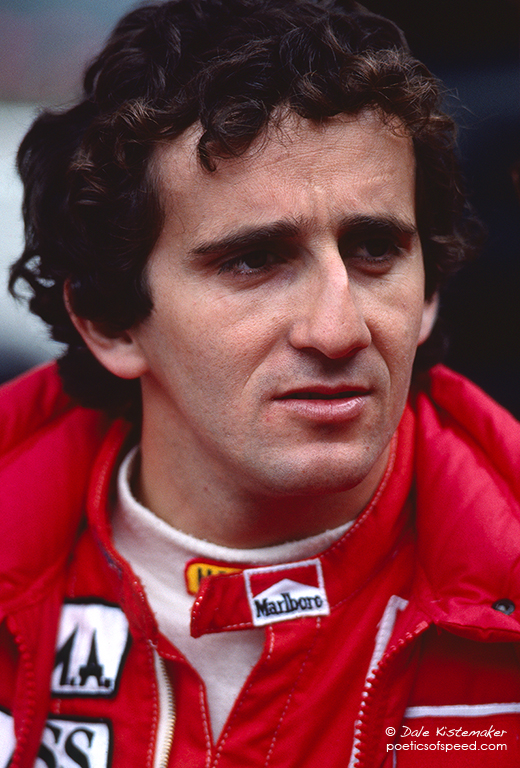
Alain Prost was known as “The Professor” because his cerebral driving style was a master class in understated consistency and control. At first I didn’t understand his reputation when others were so spectacular on the track. Finally I realized he knew exactly where the limit was and precisely drove up to the boundary but not over. Like great minimal art where a maximum is accomplished with an economy of means he drove to win “at the slowest possible speed” preserving his cars, finishing races and accumulating four World Championships.
 poeticsofspeed
You must be logged in to post a comment.