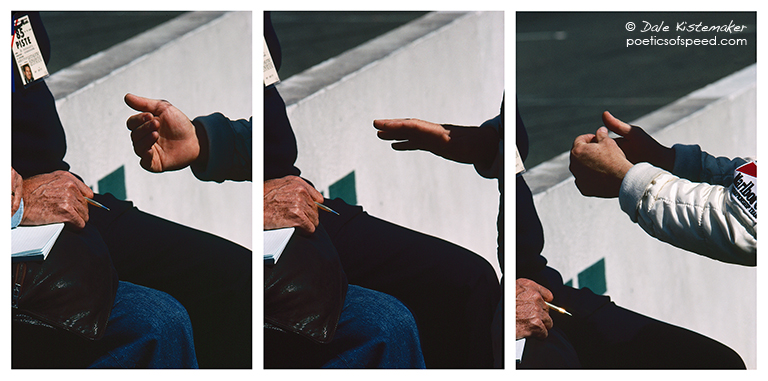
The Driver And The Journalist
The rules and regulations of racing are published by its governing body, the Fèdèration Internationale de L’Automobile in French and English. In practice the de facto language of the sport is English although it is is often the second, third, or even fourth language of the engineers and drivers. Still the most universal language seems to be hand gestures as this driver explains the behavior of the racecar to the journalist in the pits of Le Mans, 1985.
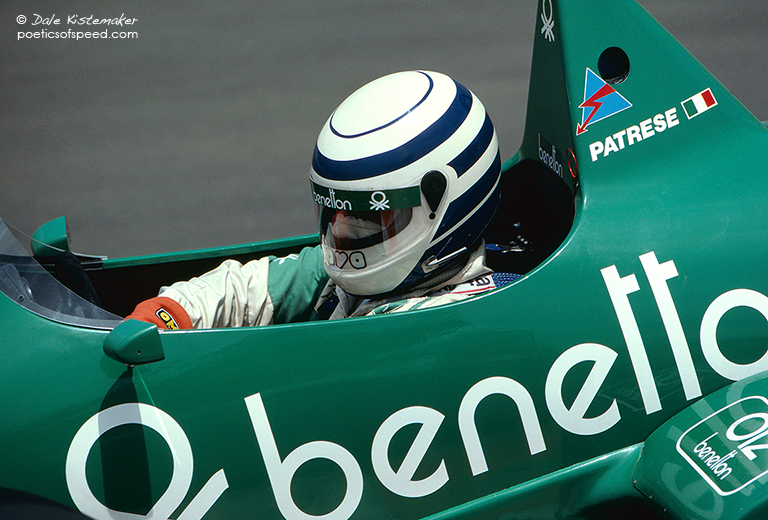
Lancia-Martini Cockpit, Le Mans
Driver in the cockpit of the Lancia-Martini. Le Mans 1985

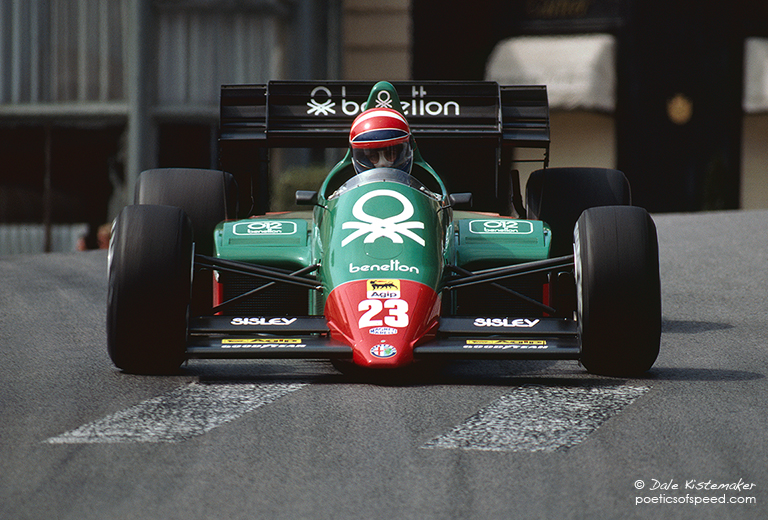
Eddie Cheever, Benetton, Monaco
At the Casino, 1984
Portrait of a Young Race Driver
Stefan Bellof 1957-1985

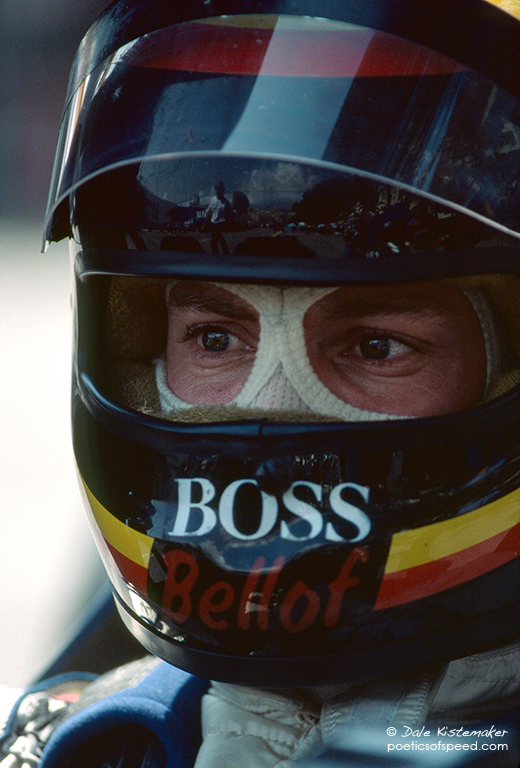
Stefan Bellof In His Helmet
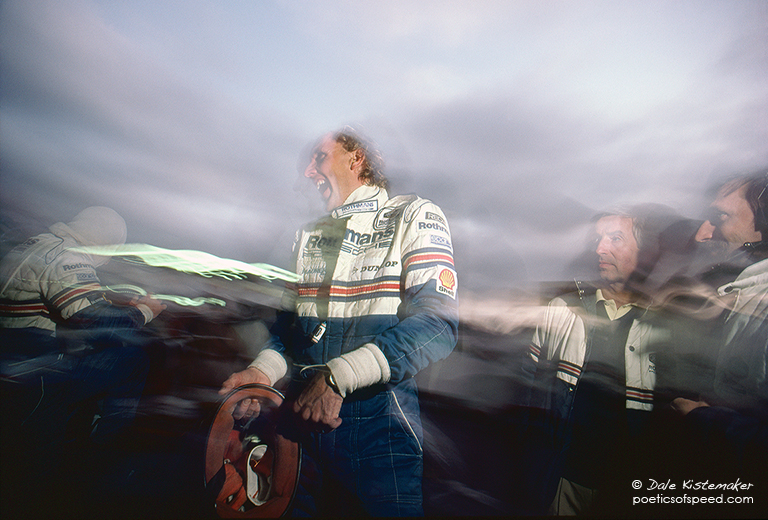
By the 1985 season Stefan Bellof was one of my favorite drivers to photograph. Although we never spoke he seemed comfortable with me working in the pits and he was great to watch on the race track. After the Detroit Grand Prix in June I was in the airport and noticed Stefan waiting for the same plane. I had my camera bag and he had a briefcase. After a brief moment of recognition we both boarded the plane without saying anything. I deeply regretted not starting a conversation but he seemed lost in concentration and I was lost for words. I vowed I would chat at the next opportunity. The Dutch Grand Prix in August of 1985 was the last F1 race I photographed and it turns out it was also his last too. On September 1 he was racing a Porsche 956 in the 1000km of Spa World Sportscar Championship in Spa, Belgium when he was involved in an accident at the fearsome Eau Rouge. He was dead before he reached the track hospital. He was 27 years old.
Stefan Bellof
In 1984 I photographed the Monaco Grand Prix for the first time. It turned into a deluge and I was so soaked my electronic F3 Nikon stopped working. I soldiered on with my old mechanical Nikon F but photography was virtually impossible because of the downpour. Yet the action on the track was riveting, the drivers were still racing flat out. Alain Prost was leading in a McLaren but there was a new crop of drivers at his heels. A young Brazilian named Ayrton Senna in his first F1 street race was brilliantly driving his Toleman (a usually uncompetitive car) and catching Prost. The rain was one of the worst ever in F1 and the race was controversially red flagged before Senna could pass. Importantly, the third step on the podium was taken by another young driver, the German Stefan Bellof in a Tyrell that was significantly down on horsepower compared to the turbo machines. He had proved extraordinary in Sports Cars. In 1983 he set the lap record at the legendary Nurburgring Nordschleife circuit in a Porsche 956 and in 1984 he won the World Sports Car Championship.
1984 was Bellof’s first year in F1. He regularly laughed with his crew yet was particularly focused and intense when it came to his driving. On the track it was clear he was an exceptional talent.
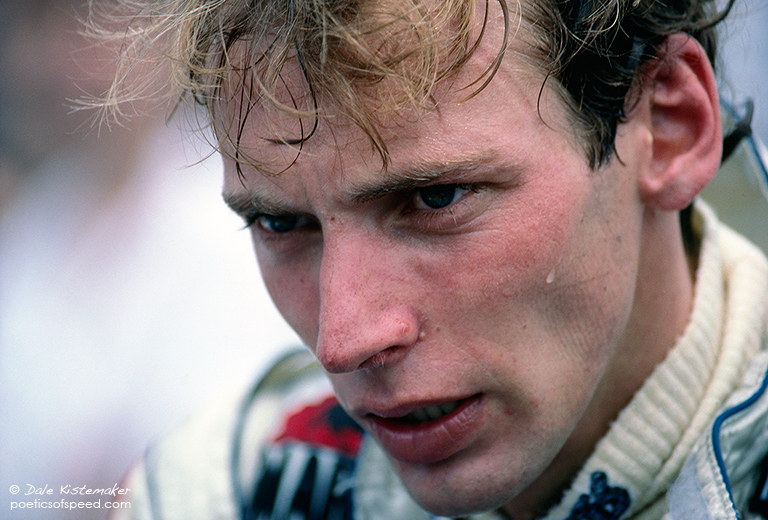
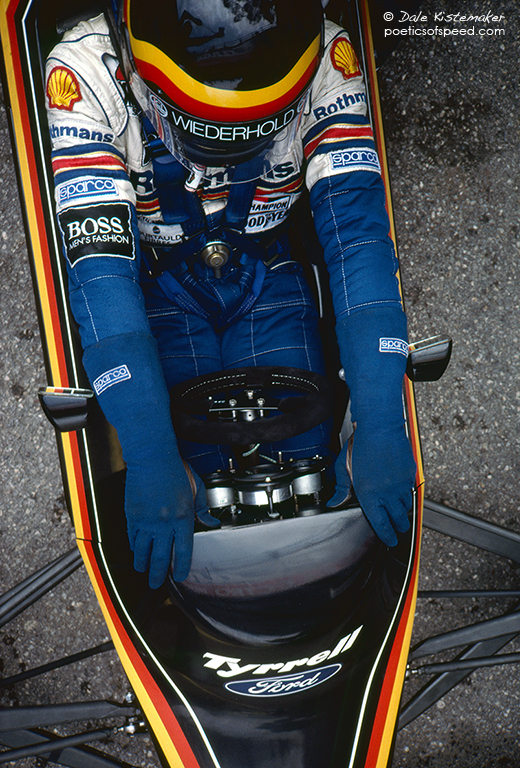
Stefan Bellof In the Cockpit
Many drivers have said you don’t sit in the cockpit of a Formula One car, you wear it. You slide down into a custom made seat that fits your body perfectly. The shoulder, lap and anti-submarining belts are cinched so tight you can’t move and the car feels like an extension of your body. The steering gives extraordinary feedback. When the tires are heated up to operating temperature and the front wheels have proper grip, the steering has weight and there is so much information through the wheel its like you are moving your fingers over the surface of the road feeling its texture. When the front end loses grip the weight lessens, the texture changes and you can feel the rubber moving. When the back end steps out you feel it through the seat of your pants. Watch a driver in the pits describe how the racecar is handling. They often turn an imaginary steering wheel one way and move their body in the opposite direction mimicking the behavior of the car in a turn.
 poeticsofspeed
You must be logged in to post a comment.