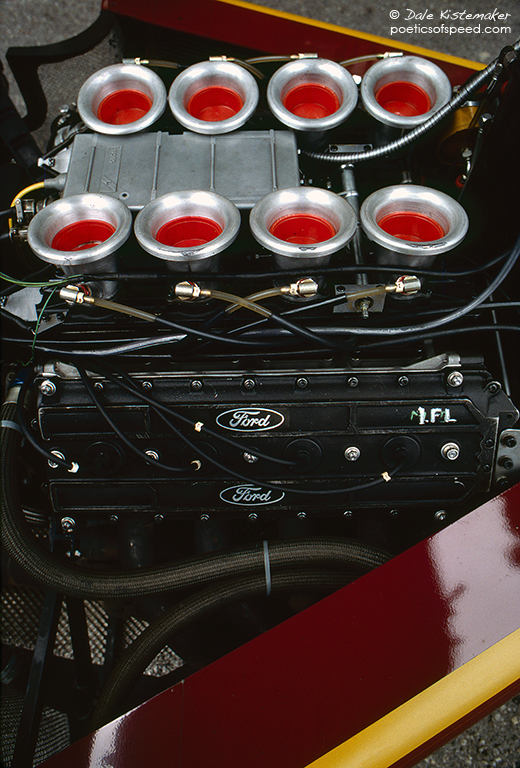
Ford Cosworth DFV/DFY 3.0 V8
In its first race the Ford Cosworth DFV 3.0 V8 won the 1967 Dutch Grand Prix powering a Lotus 49 driven by Jim Clark. The final victory for the DFV/DFY series came at the Detroit Grand Prix in 1983 with Michele Alboreto’s win in a Tyrrell. The DFY evolution produced around 520 HP at 11,000 RPM but it was less than half the horsepower of the Turbo engines in qualifying spec and a couple of hundred HP less than the Turbos in race trim. Variations of the DFV powered the CART/Champ car series and won Le Mans twice. It is one of the greatest engine designs in racing history.
The Ford Cosworth DFY 3.0 V8 in a Tyrrell at the 1984 Monaco Grand Prix:
Honda F1 Turbo
The Honda F1 Turbo engine at Monaco 1985:
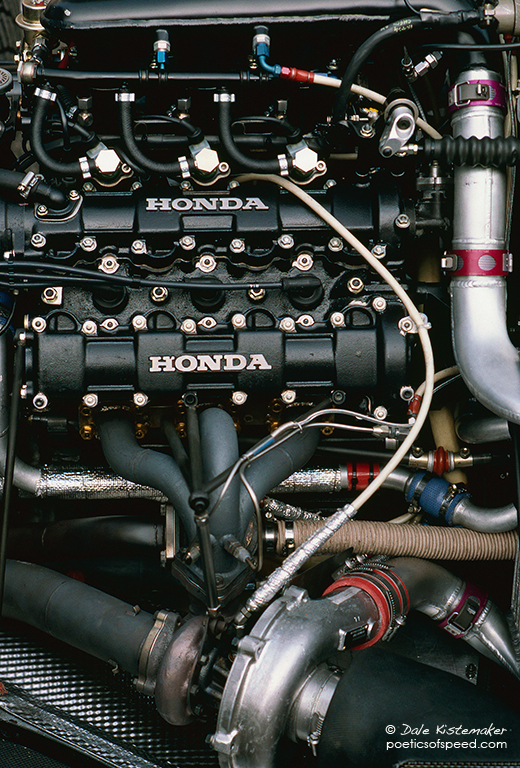
The Honda F1 Turbo made its first appearance in the Spirit Racing entry at the British Grand Prix at Silverstone in 1983 driven by Stefan Johansson. In 1984 the Honda Turbo powered the Williams Grand Prix Engineering car with Jacques Laffite and Keke Rosberg driving. Rosberg finished eighth in the Championship and then in 1985 finished third. Nigel Mansell also joined Canon Williams Honda that year and finished sixth in the Championship. In 1986 Honda inched closer with a second place result by Mansell. In 1987 Nelson Piquet was added to the team and won the Driver’s Championship with Mansell again finishing second. Their efforts gave Williams Honda its first Constructor’s Championship. Honda powered Grand Prix cars eventually won 71 Grands Prix victories from 1983-92. Honda powered five GP cars: Spirit, Williams, Lotus, McLaren and Tyrrell and won a total of six Constructor’s Championships and five Driver’s Championships.
BMW F1 Turbo
The BMW engine at Monaco 1984:

Designed by Paul Rosche, the BMW F1 Turbo was one of the most powerful engines ever installed in a Grand Prix Car. Its development problems were enormous. The November 2002 European Car Magazine featured an extensive interview with Rosche:
“…And so began one of the most exciting eras in BMW’s motorsport history. They teamed up with Brabham, then managed by Bernie Ecclestone, alongside Gordon Murray as vehicle designer and with Nelson Piquet at the wheel.
While performance was not an issue for the engine, electronics clearly were. Even for normally aspirated engines, electronic control was in its infancy in the early 1980s. “We invented the noodle soup,” said Rosche, obviously referring to some tardy wire management. The infinitely greater electronic complexity necessary for a turbocharged system led not only to many a boggled mind, but also to a large number of boggled engines. “The development was a lot of hard work,” said Rosche. “We began at the end of 1980 with the first test drive and in 1981 drove the whole year through. It was dreadful! Day and night we were on the test beds and on the track, too. It was real pioneering work in those days.”
Lacking a dynamic engine test bed, Rosche was unable to simulate driving conditions in the test cell, opting instead to do so on the test track. This led to the very first application of telemetry in racing. Nowadays a race team can tell when a driver is about to sneeze from half a mile away. But not so in 1981.
Rosche had heard that the Munich-based aircraft builder MBB had telemetry for the development of helicopters. So he bought some of its equipment and installed it in a Ford van, which had to be kept within range of the race car in order to pick up the signal. First they tried following the car around the track, which led to the screws parting company with the equipment. Then they tried hoisting the antenna 30m in the air with a balloon. That worked until the police politely invited them to stop. Finally, the poor electronic engineer with the dubious honor of driving the truck built a 3-minute memory.
At the time Nelson Piquet was the test driver. “We gave him a signal when to switch the memory on,” said Rosche. “This was a huge step forward.”
BMW’s first year in Formula One was fraught with problems, mainly due to the electronics. When they failed to qualify in Detroit, that was the last straw for the Board, who were ready to pull out.
The next race was one week later in Montreal, which also looked to be shaping up badly. “We were having huge arguments with Bernie Ecclestone and Gordon Murray. They had never failed to qualify before. I told my electronic engineer to pull everything out and fit new parts. We had to do something.”
Whatever he did, it worked. Piquet drove to victory in Montreal.
Relieved and elated, Rosche brought his engine back to Munich for analysis. “We put it on the test bed, and it didn’t work. It was completely dead. Basically, we won our first race without ever knowing why.” Rosche finds this particularly amusing, although presumably 20 years ago his sentiments were somewhat different.
BMW’s F1 glory year was 1983, when it scooped the championship, a victory that Rosche puts down largely to a special fuel developed with BASF. The fuel, which was originally used by WWII fighter planes, successfully eliminated the high-speed detonation problems being suffered by other teams at the time. But the secret was soon blown after the Italians stole a barrel of it during the Grand Prix in Monza.
In 1984, with all the teams using the same fuel, Rosche sought to regain the edge by increasing turbo pressure. “The crankshaft couldn’t take the power increase,” he laughed. “So we strengthened the housing. Then the turbocharger flew apart as a result of the increased speeds.
“That was a real pioneering time for us. In the end we never really knew how much power we had. We calculated through the intake pressure at around 1440 bhp.
“But that only lasted for one lap,” he added quickly.”
Read more:
Porsche TAG Turbo Engine
Hans Mezger, the porsche engineering genius who designed the 901/911 engine and the Porsche 917 was responsible for the brilliant F1 Porsche TAG Turbo engine. The project began in 1981 and the first running of the engine occured in 1983. The results speak for themselves with two constructor championships in 1984, 85, three drivers championships from 1984-86 and a total of 25 victories for McLaren between 1984-87.
I highly recommend the compelling Porsche and Me: Hans Mezger with Peter Morgan, published in 2012 by PMM Books. It is a fascinating insight into Hans Metzger’s life, career with Porsche and the development of his landmark designs.
This is the way the engine looked at the 1984 Monaco Grand Prix:

The Renault Turbo Engine
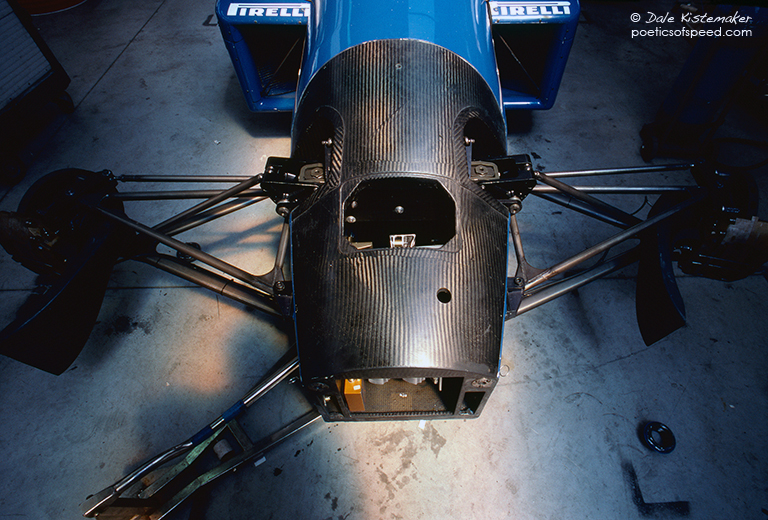
The FIA rulebook for Formula One cars specified either a 3 liter normally aspirated or 1.5 liter turbocharged engine. Renault Sport took a different route from other constructors with the power plant for its Formula One car. Driven in the last five races of 1977 by Jean-Pierre Jabouille the RS01 was the first regularly used turbo engine in F1. It proved unreliable until its first finish at Monaco in 1978. One year later Jabouille scored its first victory in the 1979 French Grand Prix at Dijon. This win ushered in the Turbo Era of Formula One and soon engines of staggering power filled the grid.
This photograph was taken at the Monaco Grand Prix in 1984:



 poeticsofspeed
You must be logged in to post a comment.