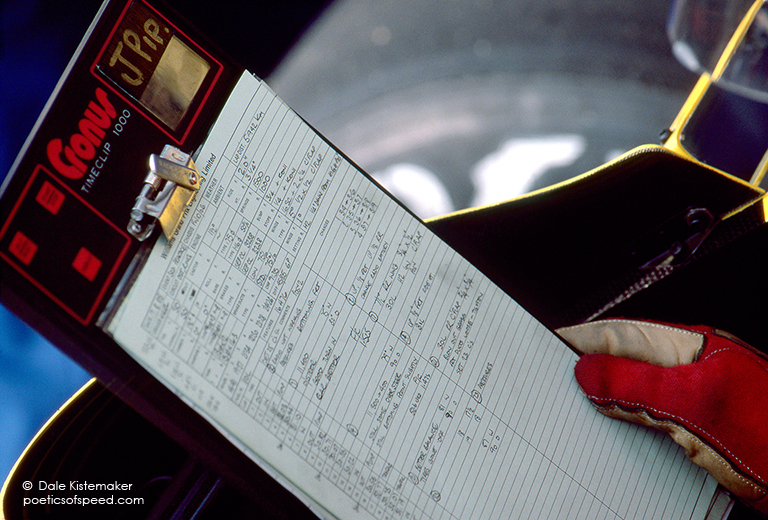
Williams Clipboard: The Rituals of Dialing In The Racecar
The usual perception of motor racing is about the spectacle and action on the track. Certainly the unfolding events of a good race can be high drama but a key element of my passion is a profound appreciation for all the “behind the scenes” hard work and subtle details in designing, building and testing race cars. This clipboard is a record of the rituals of race car problem solving.
Radio not working, bottoming front, oversteer.
Change radio battery, adjust tire pressures, up 1/8 frt, up 1/8 RR, alter ride height,
7 1/2˚ rear wing angle, 30 L RR C’ flap 3/4″x 3/4.”
Blow grass out, front ducts loose-tighten, still some oversteer, still bottoming front slightly, set 23 C’s
Better balance, good turn in, tires gone off.
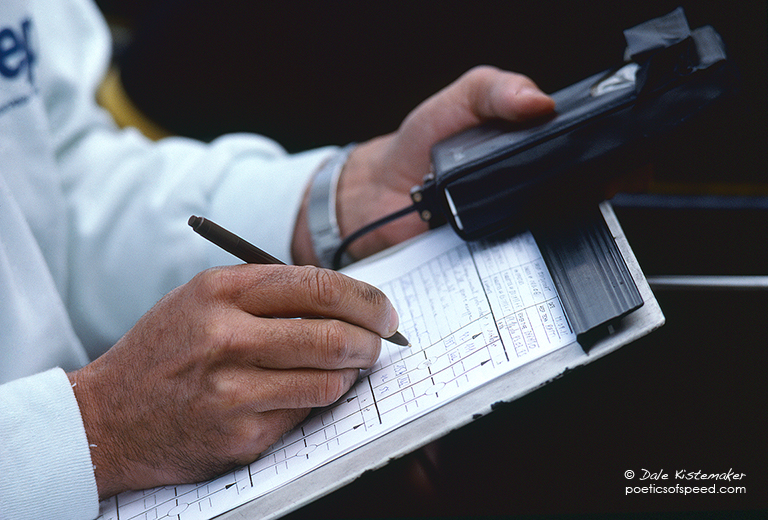
Lotus-Renault Notebook
I was astonished to find an engineer’s notebook left open on the 1985 Lotus-Renault. The pages show command settings for the wastegate, limiter, water injection and other engine parameters. The computer is an Epson HX-20 considered to be the first laptop.

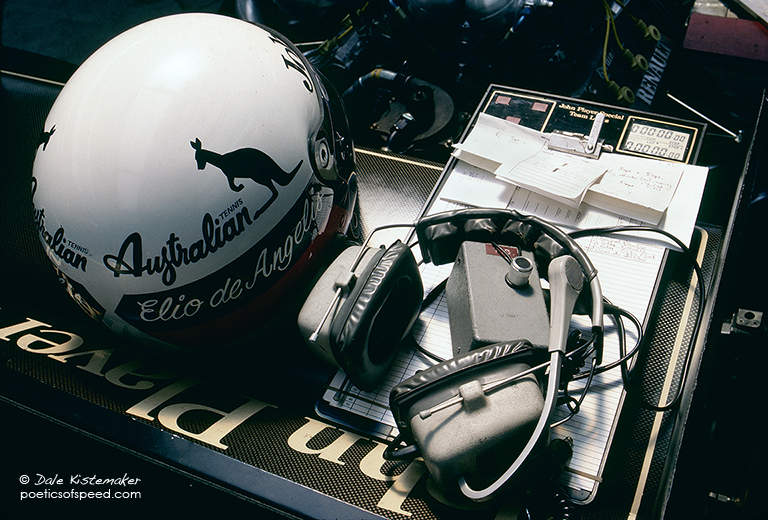
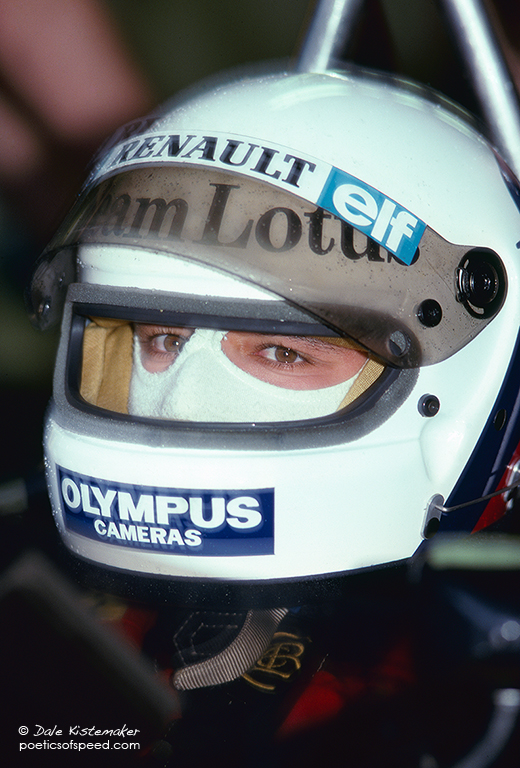
Elio de Angelis 1958-1986
Certain people move through life with a combination of intelligence, talent, modesty and elegance that is often summed up by the word class. While his background gave him many advantages his skill driving a racing car was clear. I only had a few brief conversations with him and he was the epitome of politeness. I was genuinely shocked when I learned of his tragic death in a testing accident. Racing lost a true gentleman.


Monaco: Rain
Monaco is a technical racetrack that rewards drivers demonstrating accuracy and control. Add rain and it becomes one of the most daunting, challenging circuits in the F1 calendar. My first Monaco GP in 1984 was a deluge and I wrote about how it revealed the brilliance of the two newcomers, Stefan Bellof and Ayrton Senna in my October 20, 2011 post. Although those two excelled in the difficult conditions every driver was amazing. I had difficulty walking and photographing in the torrential downpour, how they could race in those conditions was mind-boggling.

Monaco: Senna And The Edge
Despite its spectacular location the defining characteristic of the Monaco GP is the guardrail. There is no compromise, the fastest time requires every inch of track driven with total commitment and precision because the armco barrier is the edge of what is possible. In qualifying Ayrton Senna was simply amazing, drifting his Lotus up to what seemed like a millimeter’s distance from from the barrier. His six wins are still the record at Monaco.

 poeticsofspeed
You must be logged in to post a comment.