Niki Lauda’s Joke – Long Beach Grand Prix 1983
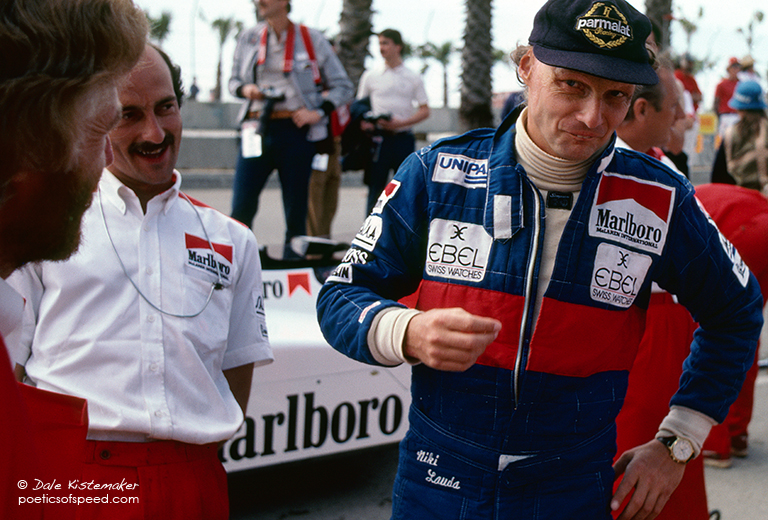 Niki Lauda was an intense, analytical and fierce competitor. But he was also a multilayered, complex person who spoke his mind clearly. Among crew and friends he also could reveal a sharp sense of humor.
…
Poetics of Speed has been receiving some significant traffic lately. Ron Howard’s movie Rush has generated interest in Niki Lauda and my portraits “Niki Lauda – Detroit Grand Prix 1984” and “Niki Lauda With Balaclava – Monaco GP 1984” have made the front page of the Google image search for Lauda and brought thousands of visitors here. Wow! Thanks!
Gordon Murray Reading The Passion And Precision Catalog – Dallas GP 1984
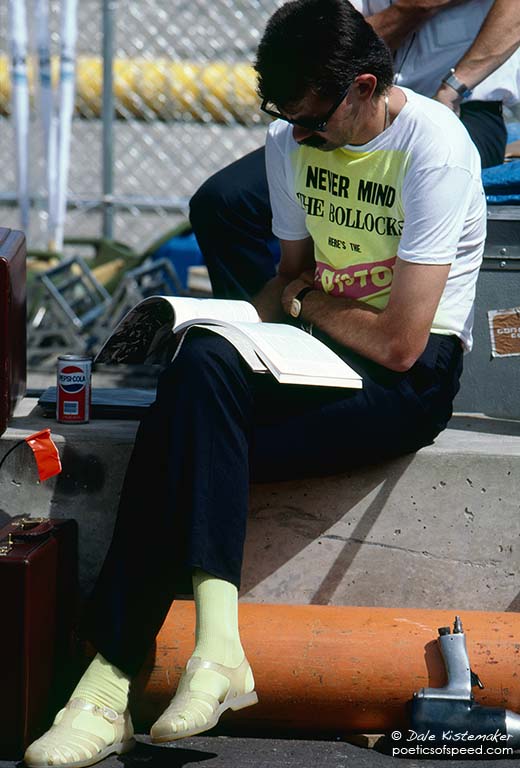 This was a great moment for me. Gordon Murray was reading his interview with me in the Passion and Precision exhibition catalog. Yes, that is a “Never Mind The Bollocks, Here’s the Sex Pistols” T shirt. No one else was anything like Gordon Murray. He didn’t just design race cars, he thought about F1 as a total system down to the smallest detail. In the few short years I had to talk with him and observe his ingenious, original thinking I had no doubt he was a great artist.
On another note, today is the anniversary of Poetics of Speed. On October 3, 2011, I began this blog as a record of my experiences photographing mid 1980’s Formula One and Le Mans racing. I never expected the enthusiastic response I’ve received and I’m grateful for the appreciation. Thank you.


Inside The Brabham Garage – German Grand Prix At Hockenheim 1983
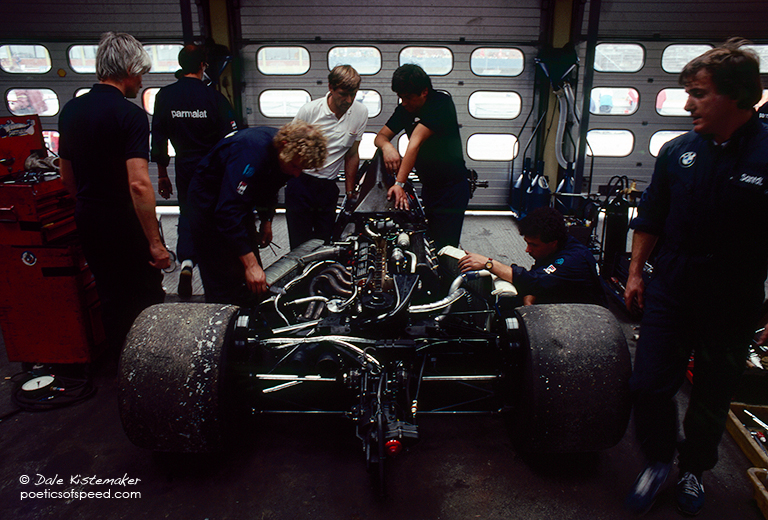 After my interview with Gordon Murray at the Silverstone GP we would occasionally chat. Some times it was small talk and on other occasions I would ask questions about a detail on the car. He was always friendly and answered the questions clearly. I never interfered when it was obviously a high pressure situation. At Hockenheim there was a thrilling moment. Practice on track was finished and one of the mechanics started closing the pit doors so the team could work in private. I was already standing mid garage and the mechanic looked at Murray and then at me and back to Murray apparently asking a silent question about my presence. Murray just nodded a brief yes and the doors came down. I found myself alone with the team as they worked on the cars. The lighting inside the garage made exposures difficult with my slow Kodachrome film. Of course I could put my flash unit on the camera but the bursts of light from it would be aggressive and ruin the circumstances. Instead I tried a few existing light exposures by handholding the camera as steadily as I could. The team ignored me and I was rewarded with the remarkable experience of being inside a Formula One team at work.
Brabham Pitstop – The German Grand Prix At Hockenheim 1983
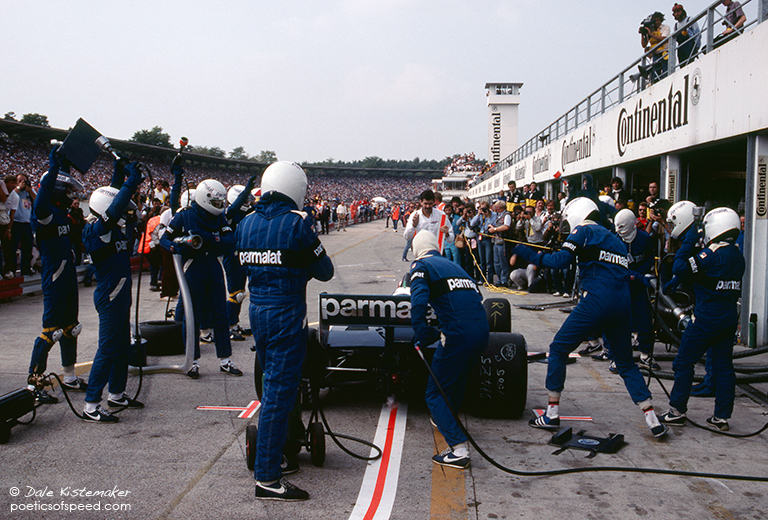 In 1982 the Turbo engines lusty thirst for gas required large fuel tanks that increased the weight of the car. Gordon Murray, like Colin Chapman before him, knew weight was the enemy so Murray devised a strategy incorporating a reduced fuel load in the Brabham for faster lap times coupled with mid race refueling. The tactic was first introduced to the modern era of F1 on August 15, 1982 at the Austrian Grand Prix. In 1983 the BT-52 design furthered this strategy. A newly designed pressurized fuel delivery system could deliver 100 liters of fuel in 3 seconds. Murray also redesigned the air gun used in tire changes to speed up the process and invented the tire warmer to pre-heat the tires so the out laps after the stop could be faster. The Brabham team was filmed practicing pit stops for greater efficiency to further reduce the time in the pits.
Around the mid point of the 1983 German Grand Prix at Hockenheim I left the track to head back to the pits. There was a huge throng of media in the Brabham pit restrained by a rope. It was impossible to fight through the photographers so I entered the empty Brabham garage and came out behind the car and crew as Murray directed the pitstop. He is in the center of the photograph holding the end of the tape laid out to precisely position the car. He orchestrated the team like a conductor. The Brabham crew each raised their hands signaling completion of their task. The pitstop was all over in seconds. Thrilled by what we had witnessed all of us around the team spontaneously applauded the brilliant performance.
Nelson Piquet In The BT-52, Hockenheim Pits In The Rain – German Grand Prix 1983

Gordon Murray Interview: Part Three:
D.K. What do you expect of the driver?
G.M. That is quite complicated. Again, that’s a two part thing. Having a driver that can interpret the car, has a feeling for it. He has got to imagine the forces, what’s happening – if it’s disastrous understeer, or just a bit of understeer, to find out what is causing the understeer, or oversteer – to fix it. But these days it’s such a complicated circus, Formula One, it goes a bit beyond that. I think you almost have to develop a friendship with a driver for a truly good partnership. You need to trust each other, to get the most out of any design. You can have the best car in the world, and if you don’t have a good relationship with the driver you will never get the best out of the car.
D.K. I’ve always respected Nelson Piquet and this year he seems to have become better.
G.M. Well, yeah. We’ve grown up together. Helped each other. He helps me by doing his interpretation very well, and he gets helped in return by me having good information, so I can make the car faster.
…
Nelson Piquet won the 1983 Formula One Drivers Championship in Murray’s Brabham BT-52. Gordon Murray designed cars won 22 Grands Prix during his tenure with Brabham. In 1987 he moved to McLaren Cars and in addition to his work with their Formula One team he conceived the McLaren F1, considered by many to be the greatest sports car ever designed. In 2007 he established Gordon Murray Designs penning the T-25 and T-27 city cars.
My profound thanks to Gordon Murray, who, in the intensely competitive world of F1, took time out of a demanding schedule to talk about the aesthetics of race car design and always answered my technical questions with patience and clarity.
“Passion and Precision: The Photographer and Grand Prix Racing 1894-1984” By Dale Kistemaker and Kent James Smith. Copyright 1984 by the Long Beach Museum of Art Foundation, the Long Beach Museum of Art, City of Long Beach, Department of Recreation and Human Services, Founders Society Detroit Institute of Arts.
No part of this interview may be used or reproduced in any manner whatsoever without written permission from the Long Beach Museum of Art, except in the case of brief quotations embodied in critical articles and reviews.
BT-52, Pits And Garage – Hockenheim 1983
 Nelson Piquet is standing hands in pockets by the right rear tire.
Gordon Murray Interview: Part Two
D.K. I am also curious about the change in the front suspension. I’m not an engineer, but between the pull-rod versus the push-rod what was the advantage of changing?
G.M. That’s another two-part story. Half, or more than half, was with the new slim shape. I just thought about turning the whole thing upside down and having it push instead of pull. Its the same system, same linkage, same geometry. It fitted into the physical layout and the total concept of the car a lot better. That was about 60 per cent of it. It looked good so we thought we’d do it; 40 per cent was that I was getting pissed off at everybody else copying the pull-rods.
D.K. How long do you think it will be before everybody’s doing push-rods?
G.M. The new Osella’s got push-rods. Almost everyone else still have the pull-rods. Its the same thing really.
D.K. You mean there is no mechanical advantage?
G.M. There is a layout advantage. There is a weight disadvantage, because things in compression have to be a lot heavier than things in tension. A small weight disadvantage but a big enough layout advantage to make it possible and practical.
D.K. As a viewer the car is beautiful. It looked right immediately.
G.M. I don’t know about other designers, but with me aesthetics certainly taints the design. I could have done two different BT52’s that would have done the job aerodynamically. One would have looked quite a bit better than the other. As you are drawing the bodywork it is quite easy to make it look aesthetically pleasing at the same time. We never make it aesthetically pleasing if it is a disadvantage, obviously because in racing you can’t make that compromise. It’s just a balance when you are laying out the lines. You get a flow.
D.K. What kind of training did you have?
G.M. Pretty mixed. In early school days I was going into art. I got hoisted out of art by a teacher and stuck into technical drawing when I was twelve. Luckily, I think. But when I was doing the technical side, I was always drawing cars or racing cars. When I went to college, I was designing and building my own racing cars. If you look around engineering design generally or industrial design -ship building, kettles, cars, bridges-anything that is right is an efficient structure at whatever it is trying to do. If something isn’t good, it doesn’t often look right. If you look at something like the Concorde, nobody said “Wouldn’t it be great to make an airplane with a long needle nose and wings that had a slight profile change.” That is how it has to be to travel 2,000 miles an hour, and it is beautiful. I love architecture, too. Practical and efficient buildings, the same is true for the job they are doing.
…
“Passion and Precision: The Photographer and Grand Prix Racing 1894-1984” By Dale Kistemaker and Kent James Smith. Copyright 1984 by the Long Beach Museum of Art Foundation, the Long Beach Museum of Art, City of Long Beach, Department of Recreation and Human Services, Founders Society Detroit Institute of Arts.
No part of this interview may be used or reproduced in any manner whatsoever without written permission from the Long Beach Museum of Art, except in the case of brief quotations embodied in critical articles and reviews.
BT-52, Pit Road Walk-About – British Grand Prix 1983
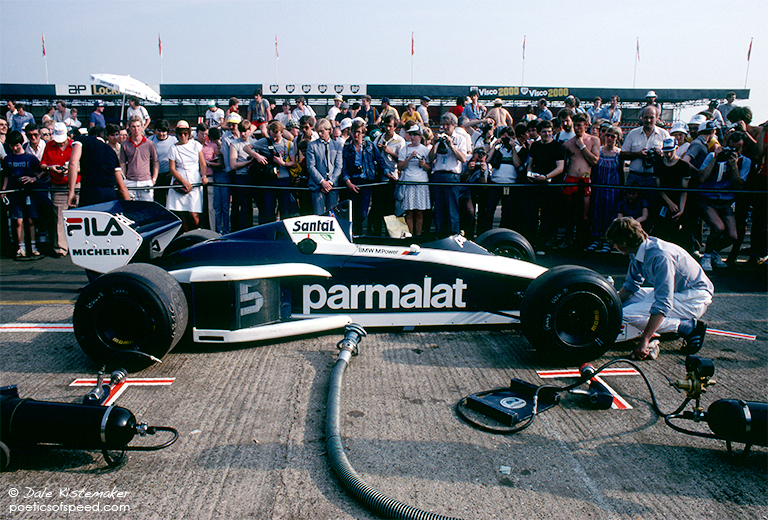 At the 1983 British Grand Prix at Silverstone the organizers opened the pits and paddock for a short time to spectators who had purchased a “Pit Road Walk-About” ticket. It was a great opportunity for fans to see the F1 cars and equipment up close.
Gordon Murray Interview: Part One
DK. Can you describe the process you go through in designing a racing car like the BT52 in three months?
G.M. A lot of it is boring. It is difficult to break something like design down into percentages. A lot of it is drawing on past experience, what you’ve done over the last ten years, what other people have done, being aware of what’s good and what’s bad. So the more experience you’ve got, the longer you’ve been around racing cars, the more you’ve absorbed over the seasons, the more you draw on. Its probably subconscious, but its there all the same.
D.K. What’s the not boring bit?
G.M. That’s difficult to define. I generally have a feel about a new car almost right from the beginning. I don’t mind doing lots of different layouts on different concepts. With this car, the reason we decided to do the breakneck bit in three months was because we thought the new rules were sufficiently different to warrant a completely different aerodynamic and mechanical approach. Also, again of the boring side, our current car was a bit of a slave in the beginning. A slave chassis, and it got developed into the BT50, and it need replacing anyway, so we thought we’d kill two birds with one stone and start with an absolutely clean sheet of paper. And all you do is read through the regulations and go around for a couple of weeks trying to keep everything else out of your mind. I find the bath is a good place. I like long soaks, and I drift off. I’ve had a lot of good ideas while soaking in the bath.
D.K. Do you actually see the shape in your mind?
G.M. Oh yes! If you can imagine all the forces and the bits whizzing up and down, the shape comes. Although the concept is one thing, the racing car is such a complicated bit of machinery. You can’t just say, “I want a car that is long and narrow and dart shaped.” You’ve got to consider where you have the major masses, to get the weight distribution where you want it. You have to consider access to the gearbox, changing an engine in an hour and a half. All that has to come into it.
Lying in the bath you might think, “We’ll get rid of the sidepods because we know they generate lift without skirts,” and at the same time you’ve got to be churning over all the other bits and pieces and fitting them together. That all came to me very quickly in a couple of flashes in maybe a week and a half. Then what you do is draw full size layouts for access and actually fitting the turbo in position, or the intercooler, or whatever it is. You find that you can’t do this or you can’t do that. Then you do another concept, and you develop that one for one or two or three days, and you have branches off your original idea. In this case we came back to almost our original shape.
The other thing you do is cross check in the wind tunnel. We spend three weeks in the wind tunnel, and it said eventually the original shape was best. Before we tested in the wind tunnel, prior to 1978 for instance, we did all the aerodynamic things just by sucking them out of the air, you know, by feel. You have to put yourself in the car and imagine what’s happening to the air in different areas. I think that disappoints a lot of people when they find that not much of it is very scientific. A lot of it is having this feel for what the air does and what the thing is going to do when its cutting through the air at 200 MPH. It is all very violent and a pretty physical thing when its thundering through the air and changing direction. It looks nice and sleek and lightweight in the pits. Afterward you rush off to the scientific back-up and go and test it in the wind tunnel and make sure what you are doing is not nonsense. A couple of times I’ve thought of a new car that in retrospect would not have worked. You’ve got to balance. You’d like to rush off and make it because it is so different, and its going to astound everybody. But you’ve got to stop yourself somewhere and say “ Ok, maybe its too much of a risk, maybe it’s not going to work.”
…
“Passion and Precision: The Photographer and Grand Prix Racing 1894-1984” By Dale Kistemaker and Kent James Smith. Copyright 1984 by the Long Beach Museum of Art Foundation, the Long Beach Museum of Art, City of Long Beach, Department of Recreation and Human Services, Founders Society Detroit Institute of Arts.
No part of this interview may be used or reproduced in any manner whatsoever without written permission from the Long Beach Museum of Art, except in the case of brief quotations embodied in critical articles and reviews.
Brabham BT-52, Truck, Trailer And Spectators – British Grand Prix 1983
 Gordon Murray Interview: Introduction
1983 was a pivotal year in the design of Formula One race cars. The under car aerodynamics of the ground effects era had been outlawed at the end of the 1982 season by the FIA, the organizing body of Formula One. I first saw Gordon Murray’s response to these new rules, the Brabham BT-52 in the paddock and pits of the 1983 British Grand Prix. I was stunned by its elegant, slim shape. The ponderous looking sidepods on earlier cars that had been necessary to support ground effects systems were gone. Instead the BT-52 had a refined and reduced arrow like body that was like an updated version of the slender, graceful 1960’s rear engined Grand Prix cars. Simply stated, the BT-52 was beautiful.
I was in Europe researching the Passion and Precision exhibition on the history of Grand Prix Photography for the Long Beach Museum of Art and was attending grand prix races to interview key Formula One professionals. Gordon Murray’s reputation for imaginative thinking had placed him at the forefront of race car innovation. I introduced myself explaining my interest in his design process. He agreed to an interview and after practice took a few moments out of his intense schedule to talk. Removing his headset he guided me to a quiet spot in a Brabham trailer where he would be free from interruption for a few minutes…
 poeticsofspeed
You must be logged in to post a comment.