Engineer’s Hands, Digital Watch And Switch Panel – French GP 1985
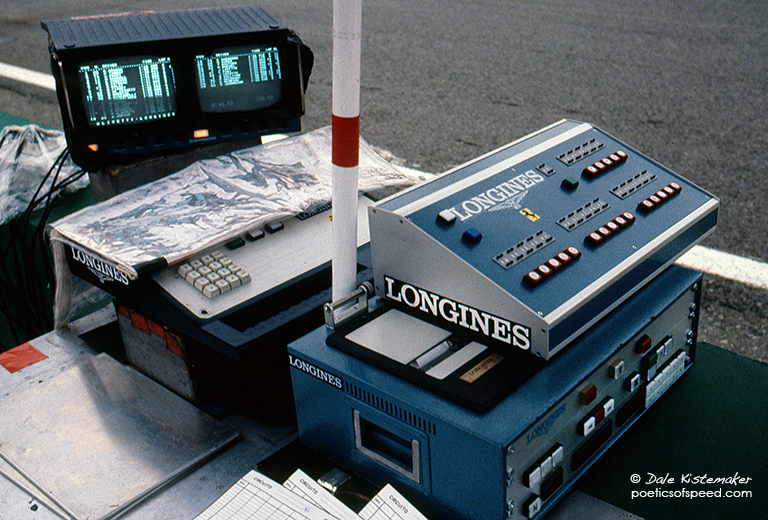
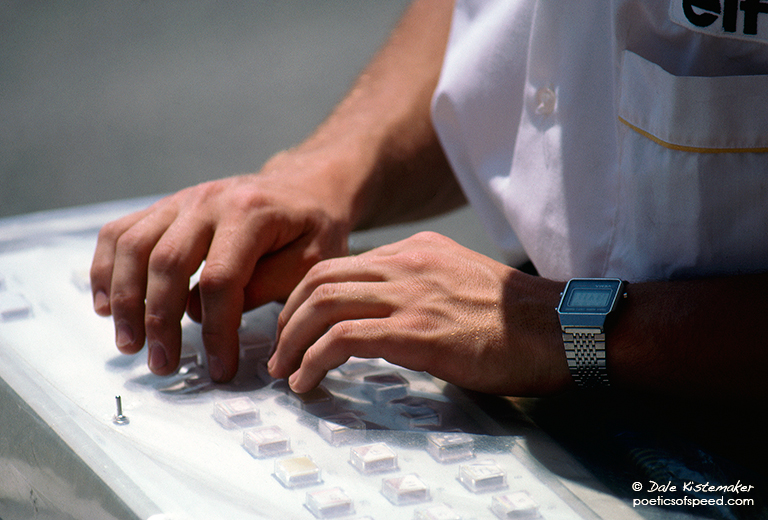 This Renault Engineer is wearing a Vema digital watch. It is similar in design to 1980’s Casio and Seiko watches but I’ve been unable to discover anything about it. If anyone has information please let me know. Speaking of mid 80’s tech, the switch panel’s function is also a mystery. The picture below shows its large size. I can’t read any specifics about the pushbuttons in the original Kodachrome. He is sitting on the pit wall and it is possible the panel is a method of recording times of other cars. Again, any info is appreciated.

HP Integral Computer – Belgian GP 1985
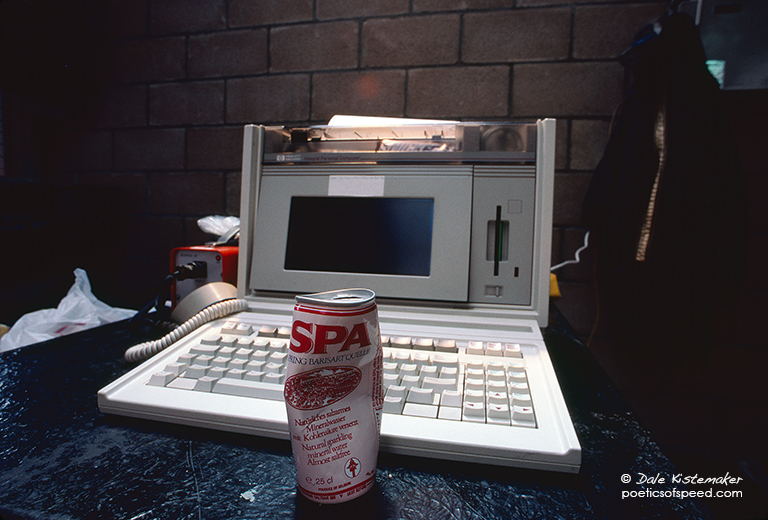 The Hewlett-Packard Integral Computer was introduced in 1984 with a built in electroluminescent screen and inkjet printer. It needed AC power but was HP’s first “luggable” computer. More information here: http://hpmuseum.net/display_item.php?hw=122.

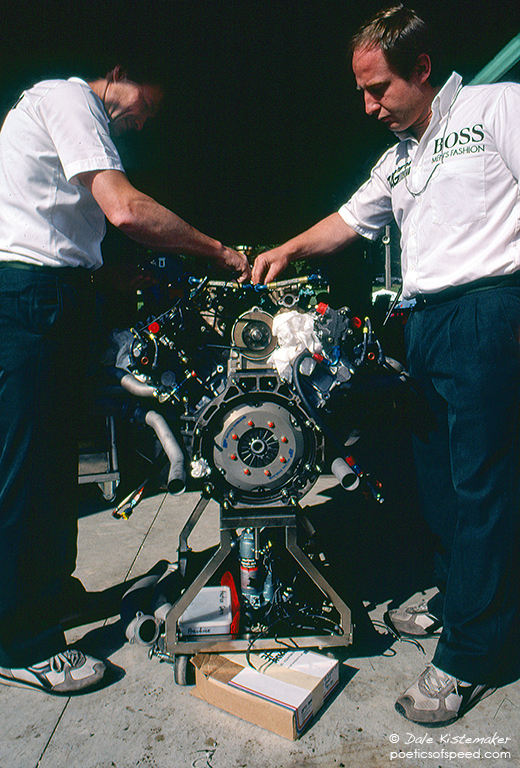
Tambay Describes His Car To Engineers While Film Crew Mounts Their Camera – Belgian GP 1985
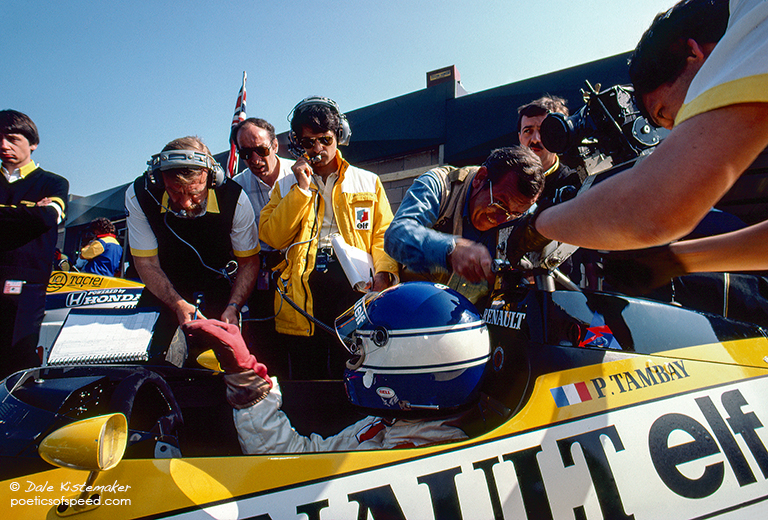 Check out my April 9, 2012 post showing earlier film camera mounts. In this GoPro age we’ve become so used to POV camera images it is difficult to realize there was a time where the on board view of an F1 car at speed was only known to the drivers. There are a number of videos available on YouTube like Anatomie d’un Depart and DVD like “Lap of the Gods” and “50 Years of Formula 1 On Board” which show archival footage.
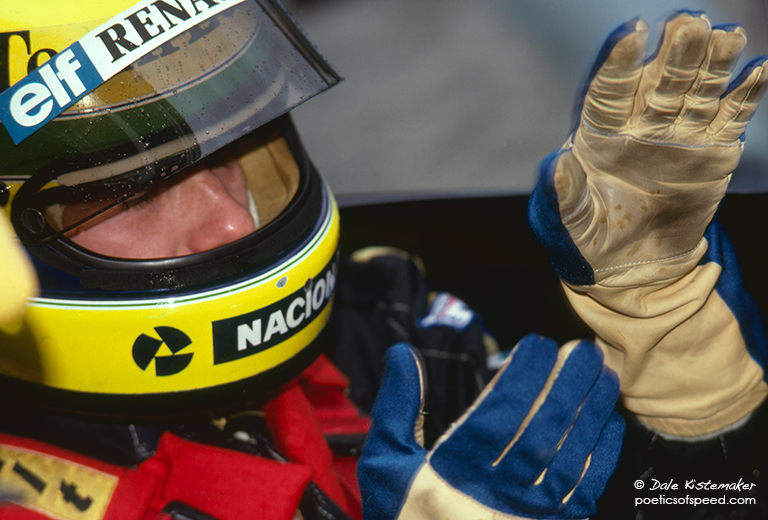
Patrick Tambay Signals To Start The Engine – German GP 1985
 The Driver’s signal to start the engine is one of the most dramatic moments in the pits. After all the frenetic activities and preparations there is a moment of relative stillness. The starter whines and suddenly, with a crack of thunder, the engine erupts into life. It is impossible to accurately describe the intensity and percussive complexity of the sound. Every type of engine has its own characteristics and its painful explosive detonations pound deeply into my viscera filling me with a Sublime combination of terror and excitement.
Keke Rosberg In The Williams FW09 Cockpit – Detroit GP 1984
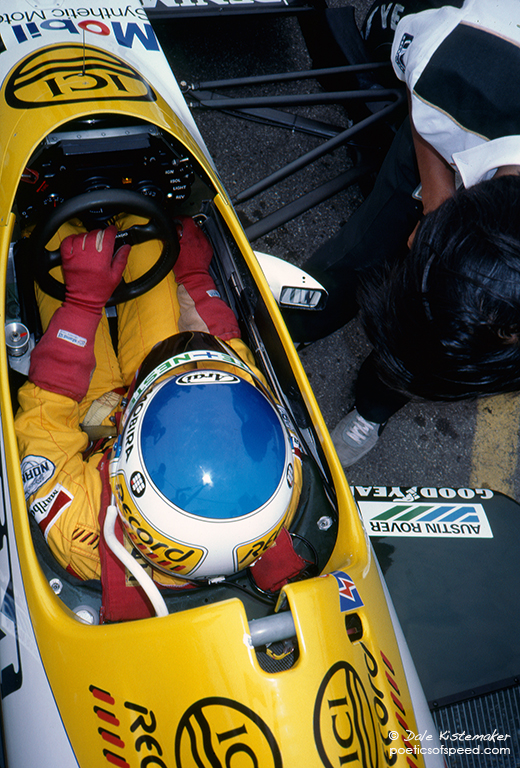 There is a small self-portrait in the blue of Rosberg’s helmet. My silhouette shows one arm bent over my head and the other straight with the flash highlight glowing from my hand. The odd pose is the result of a technique I used to help steady the camera. Pulling tightly on the neck strap with one hand and gripping the camera firmly in the other gave a triangulated stability to the camera position. This increased steadiness enabled the use of a lower shutter speed necessitated by the ASA 64 of the Kodachrome film.

 poeticsofspeed
You must be logged in to post a comment.